Friday, 7 November 2014

Himalayan 100 Race Day 1


Day 1 - 24 miles 2700m ascent

Maneybhanjang - Sandakphu

Race day dawned. We were up at 4.45am for a 5.30am departure on the bus to the start with a packed breakfast in hand. Although to be fair I was feeling so nauseous, I couldn't really stomach it (and I've never been a fan of cold egg fried rice for breakfast). Excellent nutritional start to the toughest event of my life.


The start of the of the race was in a pretty little town called Maneybhanjang. We were heading 24 miles up to a trekking hut and view point known as Sandakphu - the only place in the World where you can see 4 out of the 5 highest mountains in the World and known as the trekkers paradise. The route up to Sandakphu runs along the border with Nepal and heads into the Singalila National Park. By jeep it takes 5 hours and most trekkers take 3 days. We were running it.. in one day. 


Luckily I hadn't realised the enormity of this before we set off as I think I would have been more petrified than I was. The unknown is always better in my opinion! I'll never forget googling a YouTube video of colectomy surgery the night before I went into theatre.. take a tip from me; never do anything so stupid. The same thing applied here. Better not to know what lay ahead really.

In deep contrast to Darjeeling, Maneybhanjang was a pretty rural town, surrounded by tea plantations. It felt calm and peaceful. We were greeted with another 'Himalayan 100 Welcome Participants' banner strung across the road which marked the start and groups of villagers gathered around to watch us off. The looks on their faces was a mixture of awe and utter confusion - I guess wondering what on earth we were doing and more to the point, why? Still feeling like Royalty we gathered around as Mr Pandey and his staff organised us and got our bags into piles - drop bag for during the race and yet another bag for the finish line. The 'bag logistics' of this trip are mind blowing and yet every single bag turns up at the point it's meant to. Amazing organisation. 

Before the race started we were blessed with a traditional tibetan ceremony where the local children gave us sacred scarves. Very emotional and touching. That scarf would stay with me for the entire trip, tied tightly to my backpack. It felt like it kept me safe and I needed it to keep going. One night I lost it for about 10 seconds and was sent into a panic. I've still got it now back at home and it'll be something I treasure for the rest of my life.

But back to the race. After a bit of chat and a short speech from Mr Pandey we were off. It became very clear immediately that some of the boys (and gorgeous Georgia) intended to race it hard and they shot off into the distance. I on the other hand had a very clear intention to hold back, take things at a very sedate pace and see how I felt. That's my excuse and I'm sticking firmly to it! The initial excitement of being able to run soon came to an abrupt end about 500m down the road, when the track turned and changed into an eye-wateringly steep climb. Everyone resorted to walking, huffing and puffing, with hands on knees. Some people went very quiet, focused on the task in hand, others were chatting and cracking jokes (that would be me). A few calculations and I quickly worked out it would be like this for the next 6-7 hours. Right then. The track was rocky and very uneven and didn't make for easy running at all. It was also fairly foggy, so we didn't have great views either. Mmm it was going to be a long day.

Quite quickly I found that I'd hit the same pace as South African Simon - who was travelling the World with Gareth and just slipped this race into part of his trip - and we hooked up and got chatting. Luckily he was as 'chatty' as I was and we soon took our minds off the pain sharing our life history, discussing the implications of his beard (he'd been growing  beard for 6 months and looked like Tom Hanks in Castaway, but a little more groomed!) and putting the World to rights. Every now and then the fog cleared and we were treated to stunning views of the plantations and the valley below.  I was feeling really strong and just kept pushing on as the track climbed higher and higher.  


It was a strangely emotional day. I thought of my Dad quite a lot - he died back in 2005 - and wondered what he'd think of me doing this. No doubt he'd think it was a great idea and just wished he'd been able to come along too.  

After the hustle and bustle of Delhi and Darjeeling, it was fabulous to be surrounded by simplicity, peace and tranquility. Crickets chirping in the forest as we ran through was pretty much the only noise. The scent of the pine trees was uplifting. It was quite a meditative day and back at base camp in the evening, the others admitted to feeling the same. 


The track crept upwards and onwards and we ran through little villages and past a tiny temple perched on the side of the hill. The people who lived in the tiny shacks on the hillside here so pleased to see us and always with a greeting of 'Namaska' as we ran. They lead such a simple life and have nothing, yet seem at peace with the World. 


There was a lovely section of flat and downhill but then suddenly things started to feel much harder and we realised we were getting up into altitude. The route finished at 3600m and from around 2900m, things started getting more challenging. Not only was the track even more steep and rocky at this point, but the lack of oxygen in the air meant that breathing was harder and I started with a bit of a headache and feeling nauseous (which would be a feature for the next 3 days).  Then suddenly we heard shouting and cheering and realised we'd reached Sandakphu. One of the lovely aspects of the race is that Mr Pandey and his sidekick Mansi, hold out the finish tape for each runner every single day, so you get to 'break the tape' at the end of each stage. Even the very last runner gets the same treatment. A very small, yet important, touch which makes this race so special. Some of the others - Colorado Pat and gorgeous Georgia - who'd been back a while, came out to cheer us in which was lovely, especially since it was so cold and they were exhausted.

I was surprised at how strong I'd felt and although hadn't broken any records, was pretty pleased with my performance. To put it into context. Ben Nevis - the UK's highest mountain - is around 1300m high. We had ascended 2700m over 24 miles, completing a stage that trekkers to the area normally take 2-3 days to do - in just over 6 and a half hours. I should say I'd feel pleased with that! And dare I say it, had found it easier than I'd thought. Although probably not as easy as Gabriel who'd finished first almost 90 minutes ahead of us, followed closely by Georgia (yay one for the girls!) and then Pat and South African David.


Gathering with the other runners afterwards it was clear that everyone had had mixed days. Some had pushed it hard and found it really tough. Others were shocked at the brutality of the climb and trail. Some were on a high - me included! (well I'd survived, it was cause for celebration!) and others were in tears. There was a feeling of 'coming together' and that we were becoming a family. The raw emotion was evident on everyone's faces and it was a night I'll never forget. We were soon treated to hot soup and a delicious meal cooked by Mr Pandeys' team in one of the lodges and we all started to warm up and recover. 

To say the lodges were basic was an understatement, but they were functional and although freezing cold at night, we were safe and under cover. True to their promise our bags were on our beds and we could unpack, get warm clothes on (no showers though.. ick) and get organised. I'm proud to say that I even managed some foam rolling and trigger ball work that night (accompanied by a couple of mice running around on the floor). See, I practise what I preach! I was determined to do everything in my power to keep my body in one piece.

Bed at 8.30pm.. although not many of us slept due to the altitude (think pounding heart rate, nausea and breathlessness) with thoughts of what lay ahead tomorrow. Not to mention the promise of the views of Mt Everest at first light (cue spine tingling). I'd felt strong today, but tomorrow was another day and anything could happen...

TOP PRODUCT PICKS:

Each day I'll pick out 3 items of kit or products that saved the day. Today was:

1. Apres Hot Chocolate Recovery Drink - Amazing post run to help recover, replenish electrolytes, carbs and protein and warm up

2. Bamboo Base Layer from BAM - Soft, warm and gorgeous to sleep or run in. Kept me warm at night.

3. My trusty Brooks Cascadia Trail Shoes - 3 other runners were wearing them too. Perfect for the distance and the trail. Brilliant!


Thursday, 6 November 2014

Himalayan 100... pre-race and Darjeeling


I first heard about the Himalayan 100 about 10 years ago when friend and fellow journo Sam Murphy took part. I remember thinking at the time 'One day I HAVE to do that!'. Since then I've known lots of other friends and writers go and take part and it sounded utterly amazing. 

But before the event, I was really worried. There have been a handful of real stand out events in my life. The ones that still make the hairs on the back of my neck stand up. Helvellyn Triathlon, the Lakeland 50 and the Jungfrau marathon.. all of which were epically tough, stunningly beautiful and are etched on my memory forever. Would the Himalayan 100 compare? would it be as amazing as everyone said? I'd read a couple of blogs that were less than complimentary, including one by last year's winner Martin Cox, which was decidedly odd. What was I letting myself in for? I couldn't bear going all that way for it to be a disappointment, or worse not to finish the damn thing. Was there something they knew that I didn't?

Well.. let me tell you. There simply are not words to describe this event. Epic, stunning, amazing, brutal, beautiful.. all the usual superlatives.. just don't come close (and not even 'stupendously beautiful!' Adam Rose..) .  The whole event, the culture, the views, the route, the other runners and the whole incredible experience was simply mind blowing and it's something I'm still taking time to process

Mr Pandey - the infamous Race Director - has even described it as 'life changing'... well that's one I'd agree with. Friends and family ask me what it was like and I can just about manage a stammer of 'Oh amazing... yep just amazing'.. because I can't put it into words yet. Hopefully I'll manage it better here.

I'm splitting this blog into sections.. this one is about the pre-race build up and trip to Darjeeling. Following blogs will cover each day of the race separately.. 

Getting there

We flew from Heathrow to Delhi for the first part of the trip. I got to meet and travel with the fascinating and hugely experienced photo-journalist/adventure racer/South African super Dad, Adam Rose, who was covering the race for Sleep Monsters website. He muttered a lot about how he wasn't fit and how he wasn't going to 'race' but 'might take part in a stage or two'.. um.. he looked a lot fitter than me! did he know something I didn't? Adam had completed the Lakeland 100 last year yet still didn't feel fit enough to do this? errrmm
.... what was I thinking!??!  Anyway.. we chatted away on the flight and discussed our previous race experiences - his being far more exciting than mine. He was also carrying a bulb of garlic with him. Apparently if you eat it raw it kills off bacteria and would prevent him from getting sick. I was relying on coke. Which I don't think impressed him. Either way, neither of us did get sick, so maybe a garlic/coke combo is the way forwards?  

After an overnight flight, we arrived in Delhi. If you've never been, it is everything you might imagine, Hot, smelly and utterly chaotic. Beeping horns, entire families (complete with a couple of chickens) perched on mopeds, people walking down the middle of the road oblivious to the traffic. Glimpses of stunning Colonial architecture mixed up with deprivation and poverty of the poor living in metal sheds on the side of the road. Delhi is an assault on the senses, a contradiction of wealth and poverty, yet intriguing and fascinating. But just an overnight stop, less than 24 hours later we were on our way to the airport again and out to Bagdogra in North East India ready to head up into the foot hills of the Himalayas. 

Pre-Race


After a 2 hour flight, we arrived in Bagdogra airport. It was like taking a step back in time. Dusty, dirty and swarming with people shouting; horns beeping outside (which would become a feature of the trip!) and more chaos.  A group of nervous looking runners gathered and we were hurded like sheep onto an rather battered old metal bus 'Hurry hurry.. go to the toilet, we have 3 hours on the bus. We're going up into the mountains'. 

The long bumpy bus ride was a great way to get to know some of the other runners. By now I was even more worried.. they all seemed far more experienced and far fitter than me. 'Oh yes I've done a few ultras and stage runs and that thing in the Desert', did nothing to fill me with confidence. Ok I've done my fair share of tough races, but nothing on this scale and not for a long time. Oh and of course not forgetting that was all before having 5 abdominal surgeries and the addition of a ileostomy bag into my life.  

Anyway, I wasn't holding their superior fitness against them.. much. Everyone seemed lovely and it was great getting to know them and share our fears and experiences. I'd gone on this trip on my own and already I was making some fantastic new friends.  

What was so brilliant about this entire trip was the people. I loved the way a group of runners from all over the World were thrown together with one common goal. A race like this breaks you down and bares your soul. It doesn't matter if you're rich, poor, educated or not. It doesn't matter what your background is or where you're from. When you strap on your running shoes and step foot into an event like this; nothing else matters. We're all in it together, with one shared goal and one shared life changing experience. The support, human spirit, camaraderie and friendship from my fellow runners is my outstanding memory from the trip and something I'll never forget.

The event seemed to attract an eclectic mix of people from all corners of the World all with different personal reasons for taking part. There is certainly no one 'Himalayan 100 type'. 

There were 35 runners in total. Normally there are more, but numbers were limited this year due to a accommodation being limited at Sandakphu (one of the sherpa huts had burned down). There were also a few walkers - mostly partners of runners, and some journalists who weren't running.  

I can't mention everyone, but just to give you an example of the diversity, there was Richard - 61 years old and a fellow Geordie and dairy farmer now from Scotland - who I actually ended up running most of the race with. Bryony - another journo from Runners World in South Africa. Gareth and Simon, also South Africans who were slipping the race into their World travelling/mid life crisis. David also from South Africa, who had suffered a devastating back injury only 2 years ago and who ended up coming 2nd.. amazing. Karen - a 60 year old nursery teacher from New Zealand, probably the most determined runner in the event. Zoe - a fellow former rower - from Bristol who became a great running buddy and we ended up finishing together. There were a lot of Americans including David who had once completed Comrades in an amazing 7 hours something.. although he modestly pointed out it was a 'long time ago' and Pat from Colorado - who definitely had the edge when it came to altitude although I'm still not sure how he managed it in a pair of vibrams that looked like they'd seen better days - seriously hardcore. Then there was Sonja from Germany - modest and incredibly strong who ended up winning the ladies race and Toni who was suffering from Bronchitis from day one, but never stopped smiling. Gabriel also from Germany won the men's race, who was like a mountain goat - living and training in the Alps helped!

Whilst the race is very International, it doesn't attract many Indians, but this year there was Saahil who was from Mumbai. It took me a few days to discover he was a Hollywood actor. Look out for his movie next year which is apparently called Basmati Blues (random but true!). Then there was Chris - a lawyer from Japan, originally from Wales  - seemed to be very experienced and had done events like this all over the World. Juan from El Salvador, who turned out to be a bit of a celebrity back in his hometown. Running isn't big in El Salvador yet, but Juan is paving the way and providing inspiration with his exploits around the World. Then there was gorgeous Georgia from Bath who had run a 2:50 marathon. Christ!  And finally not forgetting 'extreme athlete' Stefan Schlett, now on his 5th Himalayan 100. Turned out Stefan was the craziest amongst us. A deca ironman finisher, multiple world record holder and some ridiculous 3000km non-stop run from Lisbon to Moscow, amongst too many other events to even begin to mention. Inspirational and utterly bonkers. 

If I wasn't feeling inadequate before the trip, I certainly was now!

Bus trip over and we arrived in Mirik - a small town in the foothills of the Himalayas. Surrounded by tea plantations and very pretty. We arrived to a welcome banner 'Welcome participants of the Himalayan 100' hung at the hotel (ha what me?!? ) and a personal welcome from Mr Pandey. Feeling like Royalty, we jumped off the bus and checked in.  

At the race briefing that night everyone was very quiet. Suddenly it was a reality. We were here and there was no backing out. After a LONG discussion about bags (remember the bag flow chart in the 57 page race booklet?!), transport and organisation issues, we all signed in and collected our race numbers. 

The race doctor pulled me to one side 'We need to talk' he said. Obviously he'd seen my medical notes. He then proceeded to give me the third degree about my surgery, my stoma, how I manage it, whether I thought I'd need IV and then gave me a lecture on how I wasn't to push myself or race. He said if anything happened they would have to take me by jeep to hospital which could take days.. (!) No air rescue here. Up until now I'd just thought my biggest issue might be getting a bit dehydrated, but now I was getting worried. What else could go wrong?! was he expecting something terrible to happen did he know something I didn't? Did he think there might be a problem with the altitude? Suddenly I wasn't feeling very brave anymore. I felt irresponsible and a bit scared. 

But we still had 2 days before the race started and a sightseeing trip to Darjeeling first. So I put my worries to one side.. plenty of time to fret yet!. Following words from the Dr however, I did up my use of alcohol hand gel (to every 10 seconds!) and started drinking even more copious amounts of electrolytes.. 

Darjeeling


An early start and we were back onto our beaten up bus and off to Darjeeling for the day, via a quick stop for photographs of the stunning early morning beauty of Kanchenjunga - the 3rd highest mountain in the World.


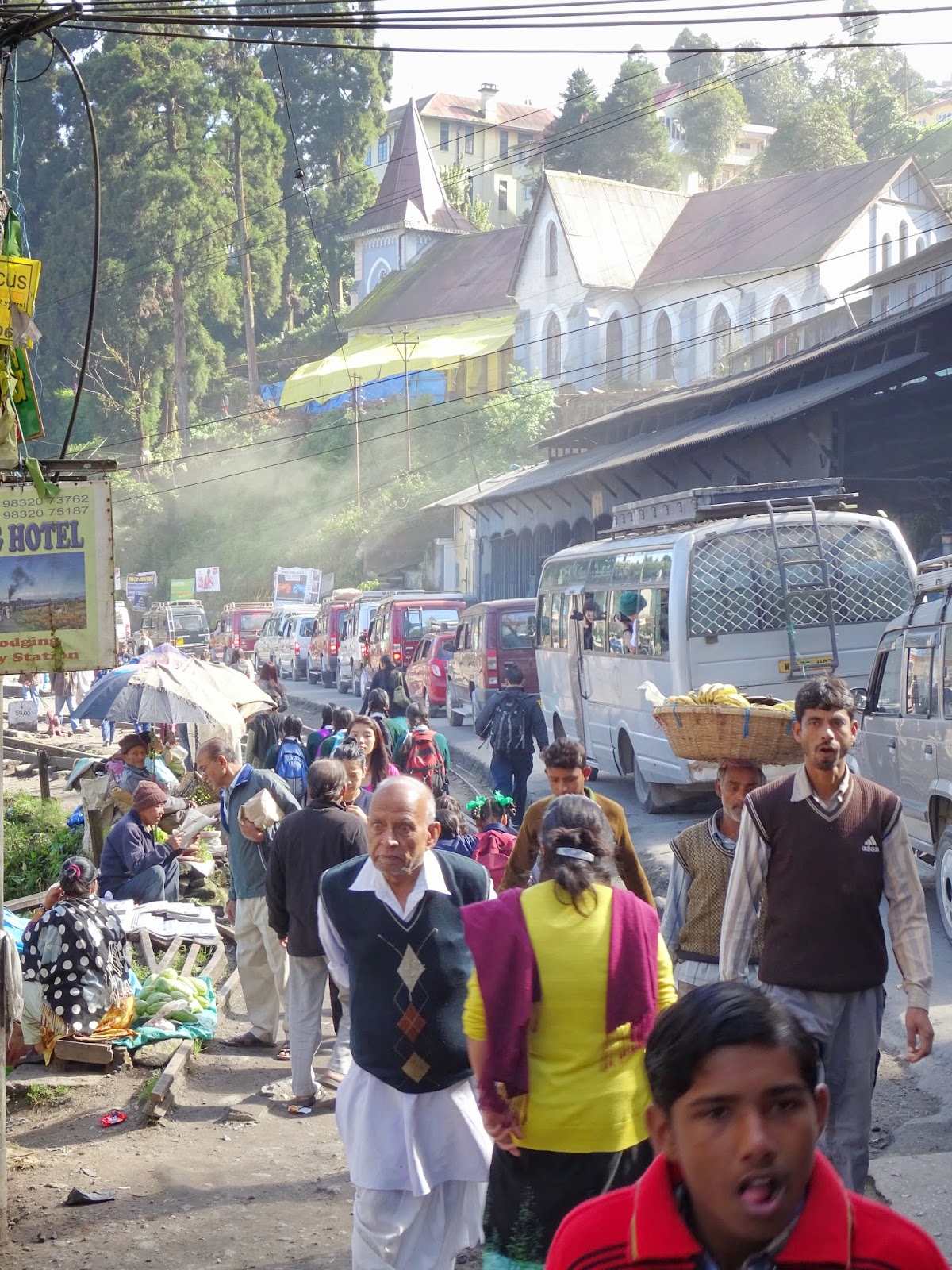
I'm not sure why I expected it - lack of research perhaps - but I thought Darjeeling would be fields of pretty tea plantations. I did not expect to find the Indian equivalent of Manchester perched on a hill overlooked by the majestic Kanchenjunga.  I can categorically say that Darjeeling is the craziest, dirtiest and most diverse, utterly bonkers place I've ever been.  It is like something from a movie. Cows and chickens mix with school children walking to school amongst dirty street vendors, selling anything from Indian spices, raw meat and Chelsea baseball caps. It's like Delhi but noisier (more beeping horns), dirtier and more rustic. The Toy Train runs along side the road on a set of tracks where people walk and cows wander all mixed up. There is no health and safety here. It's every man, woman, child and cow for themselves.  


A short trip into the mountaineering museum provided relief and fascinating entertainment. Sadly no photography allowed inside - probably to protect the historical climbing equipment and clothing. Exhibitions showing the various ascents of Mt Everest and other mountains in the area were really interesting. Clothing and equipment used by Sherpa Tenzing Norgay and Sir Edmund Hillary was incredible.. how did they do it with such heavy boots and oxygen masks? their sleeping bags didn't look very warm either and it makes you realise just what an epic achievement it was back then.   


The Darjeeling zoo was pretty grim - although I did get to see my only Red Panda of the trip - and the Toy Train.. well more dust, dirt and noise, but certainly an experience - someone said it's the highest working train in the World?  A spot of shopping, a great lunch, a quick trip to the Gurkha memorial and back to Mirik for more bag packing and serious amounts of fretting.  

Tomorrow the race would start.. definitely no backing out now.


Monday, 13 October 2014

Where in the World am I actually going?

I've had people ask me if I'm going to Nepal, or Tibet. Well the answer is neither. So where EXACTLY am I going?

The whole of the Himalayan 100 takes place in the Sandakphu National Park in an area of India known as Sikim. We'll be in India the entire time, not going into Nepal or Tibet. 

This area of the Himalayas is sometimes described as the 'Forgotten Tibet' and isn't as widely known for trekking. Which seems a shame, as Sandakphu is apparently the only place in the World where you can see 4 out of the 5 highest mountains at the same time... Mt Everest, Kanchenjunga, Lhotse and Makalu - and the views look breathtaking. The event website describes it like this:

'The 100 mile course traverses through isolated jungle, pine forests, small settlements and villages and across major rivers. Yaks, wild ponies, and the Red Panda are seen at higher elevations. At each overnight stop, meals are fully catered and accommodations are in rustic mountain huts. The race is most often described as the “Most Scenic Race in the World” that offers panoramic views of the world’s highest mountains. Sightseeing in the Darjeeling area includes the famous Himalayan Mountaineering Museum, Toy Train, and important Tibetan monasteries'.

So tomorrow (how did that come round so quickly?) I'll be flying out to Delhi, then on Wednesday onwards to Bagdogra airport. We'll then travel onto a Mirik Resort in Darjeeling, take a tour of the tea plantations and the Toy Train (which is apparently the highest train in the World) then on Saturday the race starts. I'll just gloss over that scary bit for now... 


See the little yellow 'lump' at the end of Nepal with the red star indicating Kanchenjunga? that is Sikim and is still part of India. And that's where I'm going. After the silliness of running 100 miles is over - and provided I'm still walking/alive/discharged from hospital - we are being treated to a tour of the Taj Mahal thanks to India Tourism. This really is going to be an adventure of a lifetime.

Excited?! ermm.. just a bit. And top of my list of things I HAVE TO see? A Red Panda. I wonder if I'll be able to squeeze one into my suitcase to bring home?  


Friday, 3 October 2014

Himalayan 100 kit list

Forget the running.. the kit list for this trip is taking over my life. The recommended clothing, equipment and medical list from the organisers runs to two full pages of A4 and has everything from suncream, to a woolly hat, waterproof jacket to sunglasses, superglue (!?) and a cream in case of 'buttocks rash'... (although rather ironically - thanks to my ileostomy - that could well be the only item I won't need - but then that comes with a whole other host of issues)... it goes on, and on, and on and on.... And that's before I even think about my supply of electrolyte drinks and medical supplies. 

In Delhi the current temperature is 38 degrees and in the Himalayas it will drop to sub zero at altitude. I'll need to pack for every imaginable eventuality and I'm the sort of girl that likes to be prepared. 

I might as well just charter my own plane. 

In terms of specifics, I thought I'd share some of the things on my kit list for the event itself. Being a running journalist we get to test and share almost everything that comes on the market.. which in itself is a really cool thing and makes me a very lucky girl. If you're considering an event like this or just looking for some ideas, then hopefully you might find some of these recommendations useful:


Shoes: Brooks Cascadia 9. Perfect for the rough trail with enough cushioning for the distance. I love these shoes. They've served me well on the Jungfrau marathon last year and never give me a blister. Plus Chrissie Wellington wears them.. is there a better recommendation?


Socks: I'm slightly worried about my addiction to compression socks. I've tried them all and never run without them now. I find they keep my calf muscles together and without them I break. My favourite is the CEP Run Sock 2.0 (especially in pink) - I'll be packing 5 pairs. One for every day.


Hydration pack: Again I've tried them all, but I come back to the Camelbak Marathoner time and time again. The 'vest' style works really well, with plenty of room to store snacks in the front pockets. It doesn't rub and the 2l bladder is big enough for a marathon.. or four.


Drink: I discovered SOS rehydrate earlier this year and I find the higher level of electrolytes is perfect for me. It's not very well known yet, but it should be. It's classed as a medical ORS (oral rehydration solution) but marketed as a sports drink - I have no idea why no-one has done that before now - I've been recommending dioratlye to marathon runners for years. Great for really tough events, very hot days and excellent to rehydrate you if you're feeling a bit green around the gills after a marathon or half.  I'll probably alternate this with Powerbar IsoActive just for flavour and a bit more carbohydrate.
  

And at the end of the day (providing I'm not vomiting) I'll be reaching for some Apres Hot chocolate. It was a lifesaver for me earlier in the year in the Thunder Run, so I'll be packing a case. Plus it tastes really good. If you've never tried it, then you're missing out!


Bra: Running 100 miles will certainly take it's toll on my poor boobies, so having a really good bra is essential. Again I've tried all sorts over the years, but my favourite is the lesser known Anita Extreme Control. Really soft, doesn't rub and doesn't have that 'get me out of this now' feeling to it. 

So that's just a few of the key items I'm taking with me, next blog I'll go through a few more.. Planning ahead, using tried and trusted kit and being organised is vital. As my hubby says 'Proper Preparation Prevents P*ss Poor Performance'... lets hope so!


Monday, 29 September 2014

I must be mad..

2 and a half weeks to go to the Himalayan 100. To say I'm petrified would be the understatement of the Century.  This will be the biggest challenge and the craziest adventure of my life. 

I reckon it'll be up there with surviving peritonitis and 5 major bowel surgeries. Although I guess if I can get through that lot, then maybe I've got a chance with the Himalayan 100. A new concept in how to prepare.. experience a bit of life threatening surgery to toughen you up? not sure if it'll catch on. 

I'm becoming a Himalayan 100 bore (I really am sorry!) and every waking (and sleeping) moment is consumed with thoughts of the not only the race, but the logistics. Actually.. it's all about the logistics. Consider preparing for a 100 mile race, and the distance becomes the last thing on your mind? Well that's where I'm at. 

The logistics of flying to Delhi, then onwards to Bagdogra airport is enough to keep me awake at night, let alone the thought of what will come when we get to the Himalayas. Then there's the visa, the jabs, the altitude training.. oh and did I mention the actually running training?! and not forgetting organising the kids and work back at home whilst I'm away.

The 57 page race booklet arrived from the organisers last week. It includes a baggage flow chart, a long list of essential medical and first aid supplies (I have just purchased a sterile first aid kit including needles and a canula) and a kit list that would make Bear Grylls panic.  And that's without packing all my ileostomy supplies! one thing even Bear Grylls doesn't have to worry about..

I'm beginning to question my sanity if I'm honest. Reading other blogs from previous participants indicates that vomiting, pain, exhaustion, illness and tears are regular features. Good God. What am I letting myself in for?! (Mum I hope you're not reading this). On the flip side, I get to participate in what is considered the most beautiful trail race in the World with views of Everest, Kanchenjunga, Lhotse and Makalu - 4 of the 5 highest peaks on the planet. It'll likely be one of those 'once in a lifetime' experiences and will be worth every bit of pain, lack of sleep and vomit! or at least it better had be. And this is the view that will hopefully make the whole thing worthwhile...


But in the meantime, I've still got plenty of training to do. Holding myself together with a combination of CEP Compression socks, massage from my friend Richard and physio from  the wonderful Michelle Trott and an excessive intake of Quest Immune Biotix vitamins I've got some more long runs to knock out over the next couple of weekends. So far things are going ok (dare I say it!) and without wanting to tempt fate, I'm feeling stronger, fitter and healthier than I have in over 4 years.  But there's still plenty that can go wrong. All it'll take is a calf tweak, a hurty knee or a sore throat or cold to put a spanner in the works. 

The whole thing is exhausting, stressful and beyond scary. And I'm not even there yet! Why do we do this to ourselves?! 

Follow me on twitter @runfitsarah


Wednesday, 24 September 2014

Altitude Training

Last week I took a trip to TheAltitude Centre in London to get some advice from the experts about how I might cope with the altitude in the Himalayas.


I will be running at a maximum of around 3500m for half of the event. At that level oxygen is around 13% compared to 21% at normal sea level. It will add another dimension to the challenge and could make things very uncomfortable, so I was keen to find out how I might cope and what strategies I could take to prepare better.

The higher you go, the oxygen level in the air decreases and your body has to work harder to sustain the same pace. Some people have an unfortunate reaction to altitude and suffer mountain sickness, nausea, headaches and is often so debilitating, they don’t make the summit or complete the event. 

The Altitude Centre, London boasts the biggest altitude chamber in England and is situated near Cannon Street in the City. Staffed by experts in sport science it is used by all manner of mountaineers, marathon and ultra runners looking to improve performance, but also by every day runners trying to lose weight or just to get an extra edge to their fitness. 

The benefits of training at altitude mean that when you then exercise at ‘normal’ oxygen levels, your body is more efficient and able to utilise oxygen more effectively. Precisely the reason why elite runners train at altitude in the Rockies or in the USA, so when they return to sea level their performance is enhanced. Training in a hypoxic chamber is also vital to prepare if, like me, you’re going to be running at altitude or mountaineering.  Even for recreational runners, training in a hypoxic state will raise your metabolism, aid weight loss and improve your fitness.

The main chamber (which contains a number of treadmills and spin bikes) is set at just under 2800m, which is around 14% oxygen. Immediately upon entering the chamber it felt cold and my breathing rate felt just a little higher, but nothing dramatic. Sam, a sport science student from Bath Uni, explained that my heart rate and blood oxygen level would start to decrease in response to the lack of oxygen, just by being in the chamber. 

He then took me through a hypoxic sensitivity test to see how I’d respond to higher altitude.  I had to breathe normally wearing a mask which delivered only 11% oxygen – the equivalent of being at 5000m. My heart rate and blood oxygen level started to drop immediately and I could feel myself need to suck in more air and breathe more deeply. Sam watched to see how quickly my blood oxygen level dropped to 85%. Average time is around 60 seconds. Longer is better. Mine took 130 seconds which means that (hopefully!) I’m won't be particularly sensitive to altitude sickness. Result! Sadly I can’t claim it’s because of any superior fitness or anything I’ve been doing, it’s just good luck and down to good genes. 

In fact there is some evidence that elite athletes may actually suffer more at altitude. Onto the treadmill and I had a gentle run in the main chamber at 2800m. Interval training brings about the best results, so I’ll be going back to have a crack at some harder stuff to try and acclimatise before I go to the Himalayas.  Fascinating stuff and another tick in the 'confidence' box. 


Wednesday, 17 September 2014

How to train for the Himalayan 100

The Himalayan 100 is a stage race comprising 5 days of running - 24, 20, 26, 13 and 17 mile stages. Day 3 is actually the Everest marathon and a full distance of 26.2 miles. 

But like any ultra event, the distance is only part of the challenge. The terrain in the mountains will be rough and rocky and the altitude will be a major hurdle to deal with. The highest point is around 3500m, which is high enough to cause some issues, possible mountain sickness and headaches. Then there's the issue of lack of sleep, change in food, risk of stomach upset and dehydration. 

At only 4 weeks away, I'm in that horrible phase where I can't afford to catch a cold, get ill or pick up an injury. I'm eating, breathing and sleeping the Himalayas and my entire life is being consumed by preparation and training. It's a very fine balance between doing enough training but not too much which will tip me over into injury. If you've ever run a marathon or an ultra you'll know exactly what I'm talking about. 30% of people who enter a marathon never make the startline. I'm pretty sure most of them will be because of injury, doing too much too soon or pushing too hard and burning out/getting ill.

I'm a firm believer that training doesn't need to be complicated and to a certain extent that 'less is more'. Having run the Jungfrau marathon only 12 months ago I know that I can still do the distance and on challenging terrain. But this isn't just one marathon. It's effectively 4 marathons split over 5 days. Piece of cake then..

So, what sort of training am I doing? Well it's not as you might think. I'm not following a classic 'marathon' training plan, or indeed any sort of plan. I'm pretty much making it up as I go depending on how I feel and how I'm recovering. All my running is at a comfortable pace and I'm running through lovely countryside and challenging terrain. No speed work and lots of jog/walk on the trails. Training really doesn't need to be difficult.. keep it simple. Just think about the demands of the event then match your training to those demands.                                                                                            

So, I'm trying to focus on building up my long trail runs, up to 4-5 hours. Just easy steady pace, walking up hills and concentrating on time on my feet, not on distance. Much of the Himalayan 100 will be un-runable due to the altitude and elevation, which suits me as I'm quite happy hiking up a mountain in the Lakes for hours on end. To address that I'm doing lots of squats on my TRX and plenty of walking outside of my running training. 

But it's not just the 'long run' that needs focus. I'm also trying to build up consistency and the ability to run long back to back. This requires rapid recovery after a run, then out again the next day for another long trot. This weekend just gone, I did 2 hours on Saturday, then 3.5 hours on Sunday. Then a 90 min hike after that. I have no idea if this strategy will work! I'll let you know in 5 weeks time.. 

But staying injury free is the biggest hurdle. Putting in the miles is all very well, but the stuff we do outside of training is just as important. I'm virtually living on my foam roller and trigger ball and try to spend 30-60 mins a day doing various exercises and myofascial release techniques. I'm fairly sure this is the only reason I can still run well and (touching wood) injury free so far. If you're a runner and don't own a ball or foam roller, then you're missing a trick. Go and buy one immediately! My weapon of choice is The Grid from Trigger Point therapy and also the trigger ball by the same company. Great products and great online advice. 

It's true. The more we run, the more 'stuff' we have to do outside of running to support the extra training. Massage, strength work, nutrition, sleeping and foam rolling all takes even more time, but it's worth it for an epic 'once in a lifetime' event.


Yes, preparing for an event like this is overwhelming and stressful. There's so much to think about and so much that could go wrong, not just now, but at any time over the next 4 weeks and during the event itself. It's like living on a knife edge and I could fall off at any time (I did back in 2010 when I was training for the Ironman, got ill and never made it).  All I can do is prepare, get organised, look after myself and pray that nothing goes wrong. But with each successful run (and recovery) my confidence grows and I'm beginning to feel like this might be possible. All I need to do is stay balanced on that edge.. and not fall off.